
LandWISE farmers and processors want to increase vining pea yields, and importantly reliably higher yields. Last year many farms growing processing pea crops exceeded 10t/ha. But regularly crop yields are less than half that.
 We have been trying to determine factors controlling plant density, flowering, pod number, pea number and fill in process crops. Unlike seed peas, vining peas are harvested before the life cycle is complete. Any variation in maturity causes yield loss – both quantity and quality.
A small trial at the MicroFarm saw three lines of Ashton pea seed planted on the same day, using the same drill, seeking to achieve the same plant density of 110 plants/m2.
Sub-plots in each line were covered in Cosio cover mesh or an open bird netting to remove the effect of birds stealing seed or seedlings. This is important because recent years have seen a major increase in bird numbers and damage. We had 60 pigeons eating a 1ha crop. One farm shot 600 pigeons on one crop in one day and there were still hundreds eating.
At emergence, striping effects were immediately noticeable. We attribute this to drill settings because it repeated at the same spacing across the paddock. Half the width emerged later than the rest. What surprised us was the length of delay in some areas, plants emerging up to three weeks behind.

On enquiry, we found the coulters were set differently to account for the area compacted by the tractor tyres versus uncompacted/untrafficked areas. The settings were clearly incorrect!
The trouble with this kind of issue is the delay in observing the problem. In the period between planting this crop and our observation, many, many other crops could have been planted, all to suffer a similar problem.
How big is the problem?
We’ll take samples from the three seed lines, the cover options and the planter positions just before harvest. We’ll determine their yields and see what variation we find.
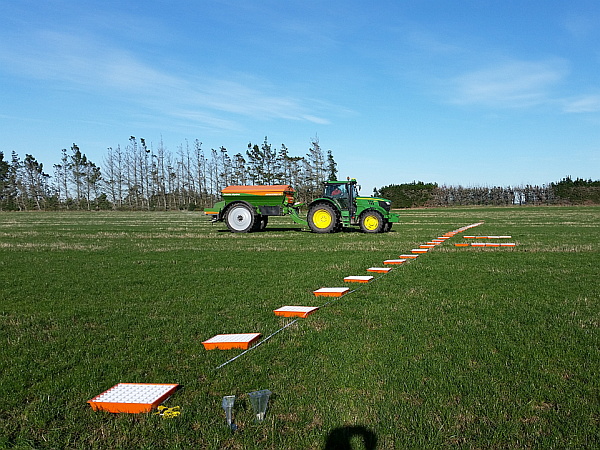
 Tray layout for a spreader pattern test
 6 – 8 PM, Tuesday 25 August 2015


 Modern farming systems are 70 years old. They have been very successful at meeting their key aim; maximising food production. However, society is asking farmers to take on new aims including providing ecosystem services to protect and enhance the environment.
 Dr Charles Merfield is the founding head of the BHU Future Farming Centre which focuses on ‘old school’ agri/horticultural science and extension.

 Plant and Food Research staff have established plots for detailed monitoring. They are doing many very detailed individual plant measurements at plot scale. LandWISE is coordinating a number of sensing surveys of the whole crop using a range of technologies.

 Page Bloomer Associates
 AgriOptics
 AltusUAS
 ASL Software


 This post looks at the first steps: getting your goals and objectives sorted. We acknowledge the original authors; Peter Stone, Andrea Pearson and Maaike Bendall (then of Crop & Food Research).